Learn how a real crime story unraveled when two words exposed a rigged lottery insider
Video: He Rigged the Lottery. Two Words Gave Him Away. (crime story)
· based on the channel Max Crime
The crime story of Eddie Tipton is the story of a man who was paid to protect a lottery and instead wrote himself into its jackpots. As information security director at the Multi-State Lottery Association (MUSL), Tipton helped run the random number generators behind games such as Hot Lotto, and he was barred from playing them. He did it anyway, planting code that let him predict winning numbers and then hiding behind a trust, a lawyer and a borrowed identity — until a store camera and two ordinary words undid him.
What made the rigged lottery scheme possible
Tipton's position gave him two things no outside player could get: access to the machines that produced winning numbers and knowledge of how those machines were audited. MUSL builds and operates the random number generators used by member lotteries across the United States, and the computers that draw the numbers are deliberately kept off the internet to prevent tampering. Tipton's job was to secure exactly that environment.
According to the investigation and his later plea, he installed a rootkit — software designed to hide its own presence — on the draw computers. The code did not simply pick his numbers. It was built to behave normally almost all the time and switch to a predetermined outcome only on specific dates, which is why the draws looked random to everyone watching and to most of the people running them. The dates were tied to numbers printed on tickets he or associates had bought in advance.
The mechanics mattered as much as the code. A rigged draw is useless unless someone can cash the ticket without being connected to the person who rigged it, and that is where the scheme was weakest.
How the Hot Lotto ticket became a problem
In December 2010 a Hot Lotto ticket bought at a convenience store in Des Moines matched the winning combination for a $16.5 million jackpot. For nearly a year nobody came forward. That silence was itself unusual: large lottery prizes usually attract a claimant within days, and lotteries begin counting down to a deadline the moment a jackpot is hit.
When a claim finally arrived, it came through a lawyer acting for an anonymous trust rather than from a person. The paperwork was filed with just over an hour to spare before the prize would have expired. Under Iowa rules at the time, a ticket could be redeemed by a legal entity rather than a named individual, which allowed the real buyer to stay out of the frame — at least in theory.
The problem for the scheme was that anonymity only covers the paperwork. It does not cover the purchase.
Two words that gave the insider away
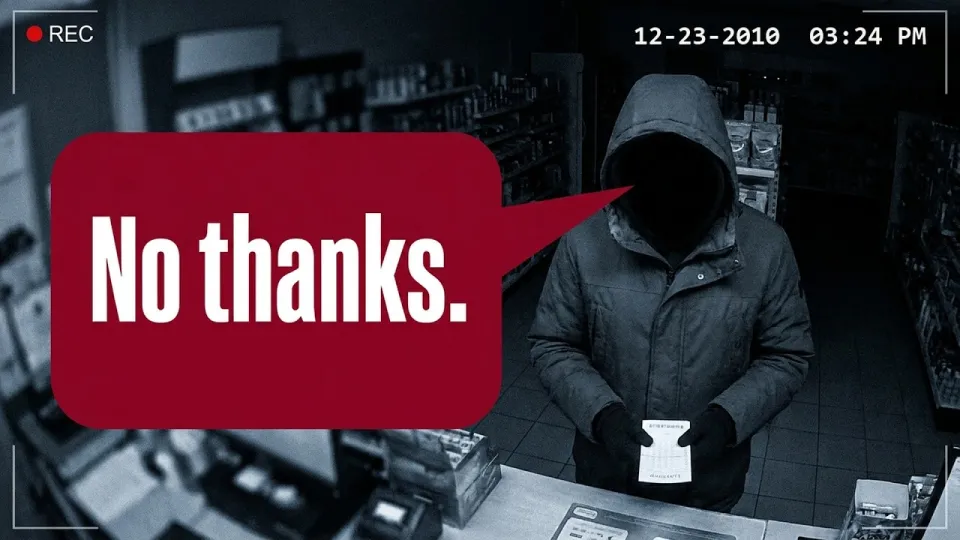
Investigators released store surveillance footage in 2014 and asked the public to help identify the man who bought the winning ticket. The recording showed a customer at the counter, and when the clerk apparently offered him something — a receipt, a second ticket, a promotional item — the man waved it off with a flat "No thanks."
That small exchange turned out to be the detail that mattered. People who knew Tipton recognized the voice and the way he moved in the video, and the phrase matched how he spoke. Colleagues at MUSL reportedly made the connection, and the identification moved the case from an anonymous trust to a named suspect.
The footage was far from perfect. The camera in the secure room where the draw computers were kept captured roughly one second of every minute, meaning any physical tampering could easily fall between frames. The store video, by contrast, caught enough of a person to be recognized by the people who worked beside him every day.
How the investigation and trial unfolded
The case moved through Iowa courts in stages rather than in one clean sweep.
- Identification and search. After the footage aired, investigators focused on Tipton, searched his home and workplace, and seized computers and records.
- Forensic work. Examiners analyzed the draw machines and found evidence that the random number generation had been manipulated, consistent with a rootkit installed to control outcomes.
- Trial. Tipton was tried in Polk County, and the prosecution built its case on the code, the ticket trail and the identification from the video.
- Appeal. A conviction was challenged on appeal, with a dispute over a legal deadline becoming a central issue before the Iowa Supreme Court.
- Plea. In 2017 Tipton pleaded guilty to manipulating the code used to generate winning numbers, admitting the core of the scheme.
The $16.5 million Hot Lotto prize tied to the Des Moines ticket was never paid on that claim. Investigators also linked the rigging method to other draws in other states, which widened the damage well beyond a single jackpot and raised questions about how many prizes had been won on numbers that were not random at all.
Why this crime story still matters to lottery players
A lottery is a trust exercise dressed up as entertainment: players accept that the balls and the random number generators are honest because someone with credentials says so. Tipton's scheme attacked the one person in the chain who was supposed to be the check on everyone else.
The case produced concrete changes. Lotteries tightened rules on who may claim a prize and how, restricted or scrutinized anonymous claims, and reviewed the physical and digital security of draw equipment. It also showed how fragile insider fraud can be — not because the code was clumsy, but because a human being had to walk into a store, buy a ticket and say something at a counter.
For anyone following true crime, the appeal of the case is that it inverts the usual pattern. There is no violent scene and no chase. There is a quiet programmer, a piece of hidden software, a deadline measured in minutes and a two-word phrase captured on a grainy camera.
The bottom line on the rigged lottery case
Eddie Tipton used his job as a lottery security insider to plant code that produced winning numbers, and the Hot Lotto ticket worth $16.5 million in Des Moines was part of that scheme. The plan survived a year of silence and a last-minute anonymous claim, but it did not survive a store recording and the words "No thanks." Tipton pleaded guilty in 2017, and the jackpot on that claim was never paid. The full breakdown of the case, from the draw room to the courtroom, is available in the Max Crime video above.
Key takeaways
- Eddie Tipton was information security director at the Multi-State Lottery Association, the body that ran Hot Lotto draws and random number generators.
- A Hot Lotto ticket bought in Des Moines in December 2010 was worth $16.5 million, yet no one claimed it for nearly a year.
- The winning numbers came from a rootkit Tipton planted on two draw computers kept offline.
- A store recording and the phrase "No thanks" led investigators to Tipton, who pleaded guilty in 2017.
- The $16.5 million prize on that claim was never paid.
Source: He Rigged the Lottery. Two Words Gave Him Away. (crime story) · Markdown version
Questions & answers
Who is Eddie Tipton and what did he do?
Eddie Tipton was the information security director at the Multi-State Lottery Association, the organization that builds and runs random number generators for member lotteries. He installed hidden code, a rootkit, on draw computers so that specific draws produced numbers he could predict, then had tickets bought in advance. He pleaded guilty in 2017 to manipulating the code used to generate winning numbers.
Why was the $16.5 million Hot Lotto prize never paid?
A ticket bought in Des Moines in December 2010 won a $16.5 million Hot Lotto jackpot, and a lawyer filed a claim on behalf of an anonymous trust shortly before the deadline. Once investigators tied the ticket to Tipton, who was barred from playing, the claim collapsed. The prize on that ticket was never paid out.
How did two words help catch him?
Investigators released store surveillance footage of the man who bought the winning ticket. When the clerk offered him something, he declined with "No thanks." Coworkers who knew Tipton recognized his voice and mannerisms, and the phrase matched how he spoke, which pointed the investigation directly at him.
How did Tipton rig the lottery computers?
He used his security access to plant a rootkit on the offline computers that generated winning numbers. The software stayed hidden and behaved normally except on selected dates, when it produced predetermined results. Because the machines were not connected to the internet and the room camera recorded only about one second per minute, the tampering was hard to detect.